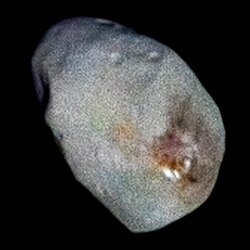
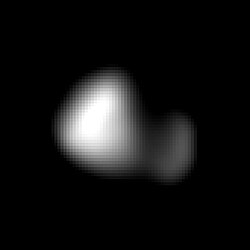
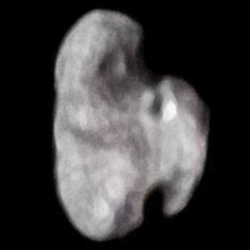
NASA / Johns Hopkins APL / Southwest Research Institute — New Horizons.
Discovered2005
Dimensions≈ 50 × 33 × 31 km
Orbital period24.85 days
RotationChaotic
A small moon beyond Charon
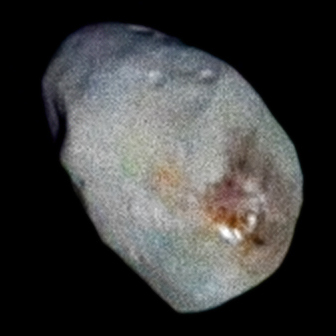
Nix is one of Pluto’s four small outer moons. It was discovered in 2005 with the Hubble Space Telescope during a search for additional members of the Pluto system. Nix orbits between Styx and Kerberos.
Unlike Charon, Nix is not tidally locked. Hubble observations and dynamical models show that it tumbles chaotically in the changing gravitational field of the Pluto–Charon pair.
Bright ice and a hint of color
New Horizons showed Nix to be highly reflective and irregular in shape. Enhanced-color images revealed a reddish region associated with a large crater, and later spectral observations provided strong evidence that its surface is covered largely by water ice.
NASA’s New Horizons mission made the first close reconnaissance of the Pluto system in July 2015.
Interactive visualization
Explore the Pluto system in 3D
NASA’s Eyes on the Solar System places Pluto in its wider solar system setting and lets you examine the Pluto–Charon system in three dimensions. Rotate the view, zoom in or out, and use the time controls to follow the modeled motion of the system.
Mouse / touch orbit and inspectScroll / pinch zoomTime controls rewind or fast-forwardFull screen best on tablets and phones
NASA Eyes is an interactive visualization provided by NASA/JPL and loads from eyes.nasa.gov. If the embedded view is unavailable, use the full-screen link above.
The Pluto system
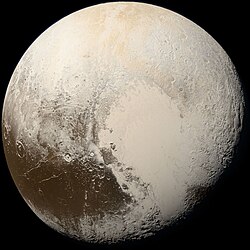
Pluto and its five moons
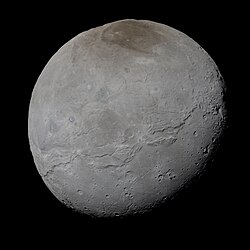
Pluto has five known moons. Charon is by far the largest and forms a closely coupled pair with Pluto. Farther out, the four much smaller moons—Styx, Nix, Kerberos and Hydra—follow nearly circular orbits around the Pluto–Charon system.